- Welcome to Happy Atheist Forum.

Just be happy.
Recent posts
#41
Laid Back Lounge / Re: Petrol head thread!!!
Last post by Dark Lightning - September 03, 2026, 11:29:53 PMDigging that color! Is that some ghostly painting on top of that tank, or a reflection? I recently had some paint repairs made on my Kia Forte. I can't stand for a long enough period to have sanded anything back and painted the parts. I would have used that catalyzed paint, too.
#42
Laid Back Lounge / Re: Petrol head thread!!!
Last post by billy rubin - September 03, 2026, 09:56:50 PMpainting! perfect weather-- no wind, 80 F or so. i have shade n the west side of the warehouse until afternoon, so i hit it all in the moring.
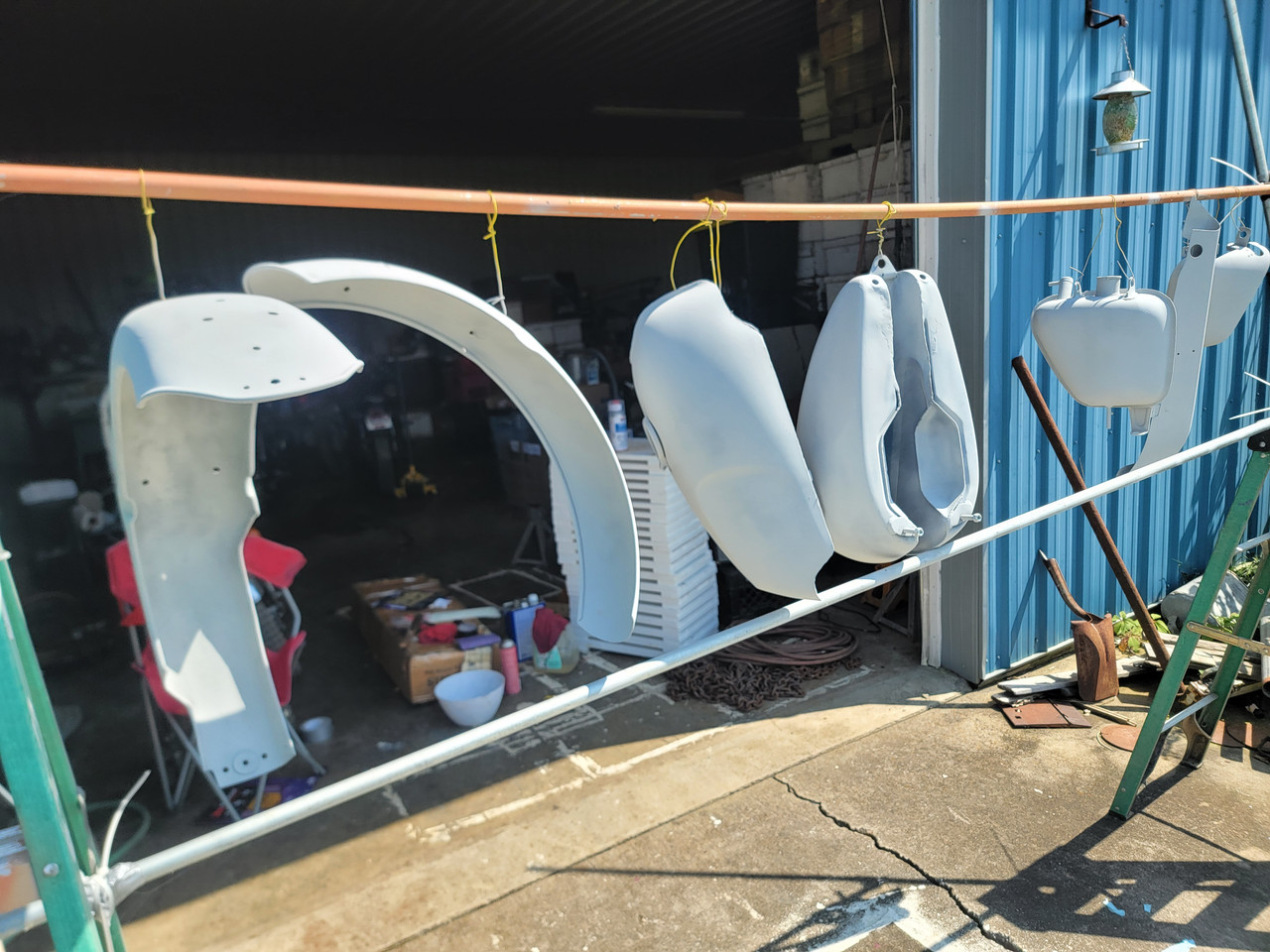
ive got a 1970 norton commando with a fibrglas tank that wont let me run ethanol fuel. i recently got a great deal on a high-quality taiwanese steel tank to use instead, but it comes in bare metal, so i had to paint it.
ive also got the 1965 triumph TR6/T120 bitsa to pull a sidecar, and all the tinware needed paint. so today i put primer on everything.
two-part epoxy isocyanate paint now comes in aerosol cans! that are easy to spray! and expensive! so far six spray cans have cost me US$216.
but getting one cup of custom-blended roman fireflake purple for the commando was US$140, so its not so bad. i was originally not a fan of the purple norton, but i confess the paint has grown on me.
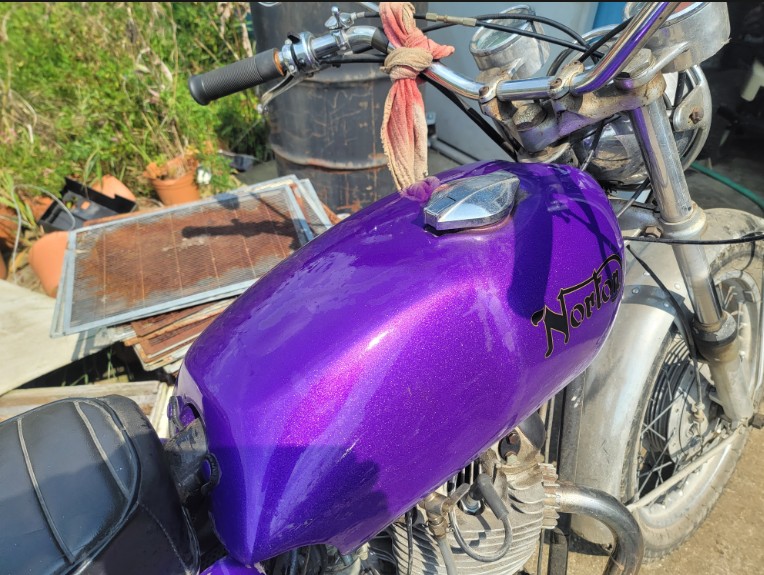
anyway, these spray cans have two-part epoxy paint similar in forumaltion to the old bulletproof imron i used to use.

theres a reservoir of catalyst inside that you break open, and then the can is good for 96 hours. one can will put one coat on a motorcycle tank, two mudguards, two sidecovers, and a chain guard.
so i sprayed the parts and now i have to wait until im ready to do the colour coats, for which i bought canned paint to use with a conventional spray gun. then i have more areosol paint for a clear coat.
paint technology has changed a lot since i did bodywork for a living fifty years ago. back then i made US$20 a day to sand and do bondo.
but painting the TR6 will get me closer to putting a running motorcycle on my sidecar, and theoretically that will help out with my deteriorating hip joints.
i can still kickstart everything okay except the norton, but i couldnt kickstart that even when my hips worked correctly. so thats not saying anything. but the sidecar outfit cant fall over if my hip joint gives out.
ive got a 1970 norton commando with a fibrglas tank that wont let me run ethanol fuel. i recently got a great deal on a high-quality taiwanese steel tank to use instead, but it comes in bare metal, so i had to paint it.
ive also got the 1965 triumph TR6/T120 bitsa to pull a sidecar, and all the tinware needed paint. so today i put primer on everything.
two-part epoxy isocyanate paint now comes in aerosol cans! that are easy to spray! and expensive! so far six spray cans have cost me US$216.
but getting one cup of custom-blended roman fireflake purple for the commando was US$140, so its not so bad. i was originally not a fan of the purple norton, but i confess the paint has grown on me.
anyway, these spray cans have two-part epoxy paint similar in forumaltion to the old bulletproof imron i used to use.
theres a reservoir of catalyst inside that you break open, and then the can is good for 96 hours. one can will put one coat on a motorcycle tank, two mudguards, two sidecovers, and a chain guard.
so i sprayed the parts and now i have to wait until im ready to do the colour coats, for which i bought canned paint to use with a conventional spray gun. then i have more areosol paint for a clear coat.
paint technology has changed a lot since i did bodywork for a living fifty years ago. back then i made US$20 a day to sand and do bondo.
but painting the TR6 will get me closer to putting a running motorcycle on my sidecar, and theoretically that will help out with my deteriorating hip joints.
i can still kickstart everything okay except the norton, but i couldnt kickstart that even when my hips worked correctly. so thats not saying anything. but the sidecar outfit cant fall over if my hip joint gives out.
#43
Laid Back Lounge / Re: What are you Eating right ...
Last post by Dark Lightning - September 03, 2026, 02:20:52 AMThread from the dead! I'm eating some tri-tip steak my son smoked, and some boiled red beets. Yummay!
#44
Laid Back Lounge / Re: What are you Eating right ...
Last post by billy rubin - September 02, 2026, 09:33:12 PMthere they are
#45
Laid Back Lounge / Re: What are you Eating right ...
Last post by billy rubin - September 02, 2026, 09:32:51 PMfor some reason the postimages dont show up. ill check back later to see.
#46
Laid Back Lounge / Re: What are you Eating right ...
Last post by billy rubin - September 02, 2026, 09:31:56 PM
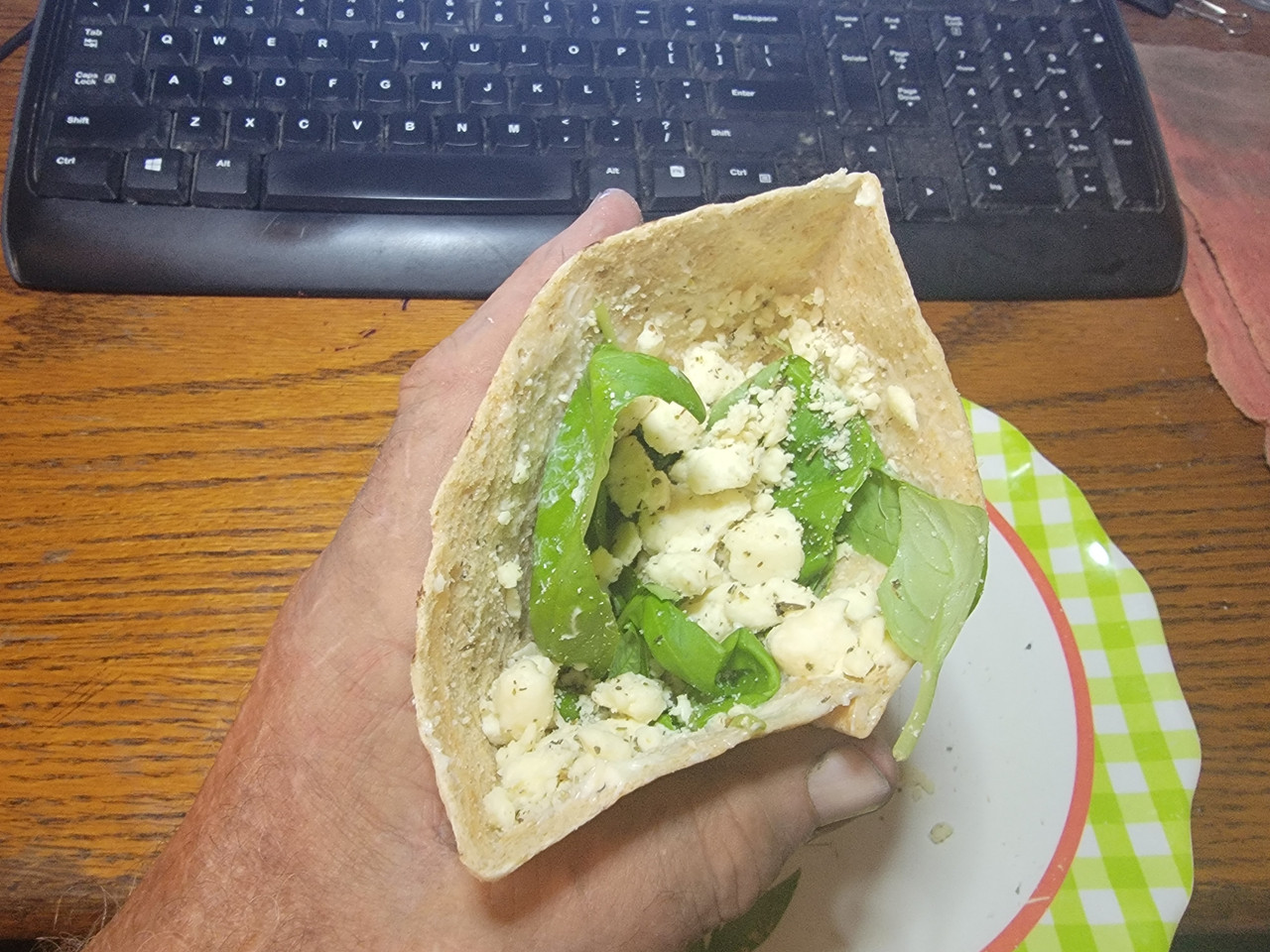
basil, butter,feta cheese, in pita bread
iran is in the news in america a lot lately. so heres something iranian.
years ago when i worked in silicon valley there was a family of iranian jews who lived up the peninsula. one of em worked in pharmaceuticals with my wife, and her husband was some sort of physicist.
there is a jewish ritual of which i misremember the name of where you stand outside the front door and stick on this little case with parchment inside with a hebrew blessing on it that reads:
Blessed are You... who has sanctified us with His commandments and commanded us to affix a mezuzah.
the mezuzah is the thing you stick on the door. all the men get to wear a kippah. the women just stand around.
anyway, we did that to their new house and then went inside to dinner.
the mans elderly mother had made dinner, and we started out with the pita thing:
--take pita bread, cut into two and open up
--spread the inside with butter
--stuff it with fresh basil leaves. if you only have old basil leaves, do the best you can. maybe mint leaves would be interesting.
--sprinkle in crumbled or chopped up feta cheese.
-- thats it.
ive been eating this in hot weather ever since. sometimes i leave out the butter, but the mans elderly mother would be scandalized. she hovered over me all during dinner, waiting and hoping for me to burp, i found out later.
#47
Science / Re: All things AI
Last post by billy rubin - September 01, 2026, 02:30:16 PMtjhis bears reposting periodically
#48
Science / Re: All things AI
Last post by Recusant - September 01, 2026, 04:00:30 AMWhen it comes to killer robots, the US (and Russia) don't want to be tied to a standard that requires human control. For them it depends on the context, and presumably in some instances they'll want to send out machines that make life & death decisions independently, not under direct human control.
The international phrase to set a standard: "meaningful human control." The US's phrase: "appropriate human judgment." Russia? Hard to say, but probably something along the lines of "We don't bother ourselves over such things."
"The three words that will decide whether robots can kill people in war" | Vox
The international phrase to set a standard: "meaningful human control." The US's phrase: "appropriate human judgment." Russia? Hard to say, but probably something along the lines of "We don't bother ourselves over such things."
"The three words that will decide whether robots can kill people in war" | Vox
QuoteFor the first time in the Russia-Ukraine war, as reported recently in the New York Times, three Ukrainian civilians were killed by a Russian drone, developed, designed and released by humans, that, in the end, selected its target autonomously. And this new reality is shaping up to be the future of warfare.
That's because a number of countries, including those with the world's most consequential militaries, are rejecting the idea that human beings need always be in control of weapons in war.
Instead, as new autonomous weapons technologies become more capable and existing international legal frameworks struggle to keep up, some countries are embracing a more expansive view of human responsibility: that people can exercise enough control not by approving each strike, but by designing, testing, and setting the rules under which a given weapon operates.
[Continues . . .]
#49
Laid Back Lounge / Re: Multi-Association Thread
Last post by billy rubin - August 30, 2026, 11:45:41 PMive watched em do that right in front of me
#50
Laid Back Lounge / Re: Multi-Association Thread
Last post by Recusant - August 30, 2026, 05:25:18 AM