- Welcome to Happy Atheist Forum.

Just be happy.
Recent posts
#1
Religion / Re: Who Would Have Thought?
Last post by Recusant - September 18, 2026, 06:13:02 PM I suppose I shouldn't laugh, it's all very serious.
Still, it's remarkable how they all managed to come off looking like muppets (British sense of the word).
#2
Science / Re: All things brain...
Last post by Recusant - September 18, 2026, 05:19:06 PMWhat some call the "reptile brain" (controlling elemental aspects of our physiology) is apparently older than reptiles. In fact its origin appears to be in a separate aspect of the nervous system which existed long before reptiles.
"Human brain is two separate organs, research finds" | Medical Xpress
The paper is behind a paywall.
"Human brain is two separate organs, research finds" | Medical Xpress
QuoteFor centuries, scientists have thought of the brain as a single, unified organ. But new research led by Stanford Medicine reveals that what we call the brain is two distinct organs that evolved independently over hundreds of millions of years.
The discovery overturns a prevailing model of brain development. For decades, researchers have subscribed to the theory that a single progenitor cell early in development gives rise to the entire brain. This model suggested all parts of the brain shared a common developmental origin.
The new findings show that the human brain consists of two ancient nervous systems packaged together—a more primitive part that regulates our hearts' beating, breathing and other functions, and another that makes us distinctly human, capable of poetry, mathematics and wondering about our own origins.
[. . .]
The researchers' breakthrough came from studying the earliest moments of embryonic development, during a stage called gastrulation, when the body first takes shape. Jokhai and Dundes discovered that the hindbrain follows a separate developmental path, running in parallel to—rather than branching off from—the pathway that creates the forebrain and midbrain.
The researchers learned this by examining developing mouse embryos. They identified two different brain progenitor cells. One, which expresses a gene called Otx2, is destined to become the forebrain and midbrain. The other, which expresses a gene called Gbx2, is committed to forming the hindbrain. They showed that these two cell populations never overlap; they are mutually exclusive from the earliest stages of development.
[. . .]
[T]he researchers looked back over 550 million years of evolutionary time. They found the same two-origin brain pattern in chickens, zebrafish and, remarkably, acorn worms, tiny creatures living on the ocean floor that share a distant common ancestor with humans. Jellyfish, which diverged from humans about 600–700 million years ago, have two nervous systems at different ends of their bodies.
"Our research suggests that evolution took two existing neural systems and pushed them together spatially," Loh said. "Having the brain as one organ would probably be more efficient, but we rely on this primordial way to make the brain as two separate pieces."
[Continues . . .]
The paper is behind a paywall.
QuoteWhen and how different brain regions diversify from one another remains unresolved. Does a common neural ectoderm progenitor generate the entire brain? Or do multiple neural ectoderm progenitors exist, each restricted to form specific brain regions?
Here our lineage tracing studies of mouse embryos support the latter model. Two parallel brain progenitors emerge simultaneously during gastrulation: anterior neural ectoderm (forebrain/midbrain progenitor) and posterior neural ectoderm (hindbrain progenitor). Differentiation of human pluripotent stem cells into anterior or posterior neural ectoderm-like cells revealed these were lineage committed to forebrain/midbrain versus hindbrain fates, respectively. They harbored diverging chromatin landscapes foreshadowing future forebrain/midbrain versus hindbrain identities.
We further differentiated human pluripotent stem cells into hindbrain rhombomere 5/6-specific motor neurons, which were hitherto difficult to generate in vitro. Hence, we postulate the brain is a composite organ emanating from two lineage-restricted progenitors; these dual progenitors may be evolutionarily conserved across 550 million years from hemichordates to mammals.
#3
Religion / Re: Evangelists
Last post by zorkan - September 18, 2026, 12:38:01 PMWrong to just say British society is to blame.
Irish 'Troubles' originate from Scottish Presbyterians being planted in Ulster in the 17th century by King James (a Scot).
https://www.theirishstory.com/2024/06/02/the-plantation-of-ulster-a-brief-overview/
https://www.aljazeera.com/news/2021/12/24/india-hindu-event-calling-for-genocide-of-muslims-sparks-outrage
https://www.abc.net.au/news/2008-01-03/genocide-in-kenya-after-election-bloodshed/1001442
Irish 'Troubles' originate from Scottish Presbyterians being planted in Ulster in the 17th century by King James (a Scot).
https://www.theirishstory.com/2024/06/02/the-plantation-of-ulster-a-brief-overview/
https://www.aljazeera.com/news/2021/12/24/india-hindu-event-calling-for-genocide-of-muslims-sparks-outrage
https://www.abc.net.au/news/2008-01-03/genocide-in-kenya-after-election-bloodshed/1001442
#4
Religion / Re: Who Would Have Thought?
Last post by zorkan - September 18, 2026, 12:26:22 PM #5
Religion / Re: Evangelists
Last post by billy rubin - September 17, 2026, 07:16:15 PMbritish society has long promoted a violent and murderous culture. since long before orwell. its who they are, just like in my country.
ask the irish. or the indians. or the kenyans.
whats religion got to do with it?
ask the irish. or the indians. or the kenyans.
whats religion got to do with it?
#6
Religion / Re: Evangelists
Last post by zorkan - September 17, 2026, 11:35:41 AMEver since Orwell.
George Orwell's most famous quote about war is "War is peace, freedom is slavery, ignorance is strength," from his dystopian novel 1984.
"The war is not meant to be won, it is meant to be continuous. Hierarchical society is only possible on the basis of poverty and ignorance."
Religion suggests that sacred violence is a form of peace.
George Orwell's most famous quote about war is "War is peace, freedom is slavery, ignorance is strength," from his dystopian novel 1984.
"The war is not meant to be won, it is meant to be continuous. Hierarchical society is only possible on the basis of poverty and ignorance."
Religion suggests that sacred violence is a form of peace.
#7
Science / Re: The Smith Hat and Light
Last post by Recusant - September 16, 2026, 05:04:51 AMAgreed. Photons can still show us new things. It's intriguing that there is some subtle regularity lurking in the non-pattern of the Smith hats.
When doing further investigation of this, as I often do with interesting science news, I found that while the science news site published it just now in September, the paper came out in July. There are a couple of articles about it on a site called "ScholarPeer." I'm not sure about the authorship of those articles though. These days people seem to make a point of signaling that they wrote a piece, not AI. When I see an anonymous byline ("ScholarPeer Editorial Team") I suspect AI.
Still, the description of the creation of the Smith hat (a retired print technician in Yorkshire came up with it), and explanation of how the shape relates to non-repeating crystalline structures seemed good to me.
That's in "What Is the Smith Hat?". There's another from the same site on the topic which at least has a human byline: "One Tile Shape Makes a Chip Care Which Way Light Spins".
Missed in the OP: The paper itself is open access:
"Chiral diffraction from aperiodic monotile structure" | Nature Communications
When doing further investigation of this, as I often do with interesting science news, I found that while the science news site published it just now in September, the paper came out in July. There are a couple of articles about it on a site called "ScholarPeer." I'm not sure about the authorship of those articles though. These days people seem to make a point of signaling that they wrote a piece, not AI. When I see an anonymous byline ("ScholarPeer Editorial Team") I suspect AI.
Still, the description of the creation of the Smith hat (a retired print technician in Yorkshire came up with it), and explanation of how the shape relates to non-repeating crystalline structures seemed good to me.
That's in "What Is the Smith Hat?". There's another from the same site on the topic which at least has a human byline: "One Tile Shape Makes a Chip Care Which Way Light Spins".
Missed in the OP: The paper itself is open access:
"Chiral diffraction from aperiodic monotile structure" | Nature Communications
QuoteAbstract:
Aperiodic systems, such as quasiperiodic structures, exhibit properties distinct from those of periodic structures. In 2023, Smith et al. discovered an aperiodic structure based on a single tile shape that can tessellate the plane only aperiodically, known as an aperiodic monotile.
Here, by using this monotile tiling, we propose a quasiperiodic structure which possesses perfect threefold rotational (C3) symmetry but lacks mirror symmetry. Diffraction experiments reveal quasicrystalline properties of the proposed aperiodic structure through observation of clear Bragg peaks and independence of illumination position.
Furthermore, we observe chiral properties including pinwheel-like diffraction patterns and unconventional circular-polarization-dependent behavior, which is absent in conventional quasiperiodic structures with mirror symmetry. These findings establish chiral quasiperiodic structures as a platform for studying aperiodic systems beyond traditional quasicrystals, broadening the study of nonperiodic structures.
#8
Science / Re: The Smith Hat and Light
Last post by Dark Lightning - September 16, 2026, 02:06:44 AMI saw that this morning. Very cool!
#9
Science / The Smith Hat and Light
Last post by Recusant - September 15, 2026, 11:05:19 PMCertainly we've had threads that have least mentioned Penrose tiling and related ideas. I'm pretty sure there's at least one devoted solely to that topic, but a few stabs with the site search didn't bring anything up that seemed to fit the bill.
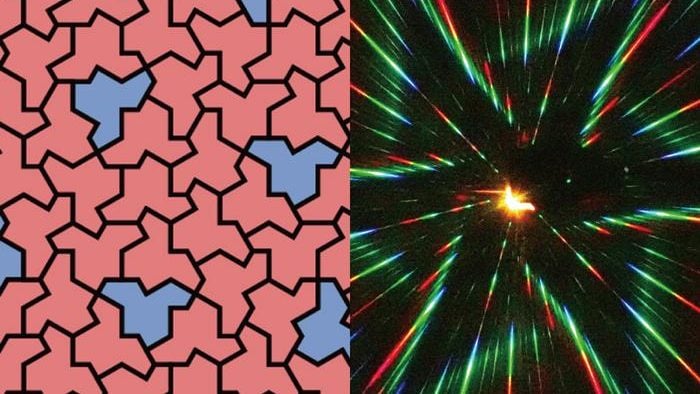
Thus a new thread it born. I think this is just really cool. A "Smith hat" is a 13-sided polygon that fits the bill: a single shape that can cover a surface without ever repeating. Somebody came up with the idea of shining light through a transparent surface covered by the Smith hat shape. . .
"The shape behind the Einstein problem just revealed strange new physics" | ScienceDaily
Thus a new thread it born.
I think this is just really cool. A "Smith hat" is a 13-sided polygon that fits the bill: a single shape that can cover a surface without ever repeating. Somebody came up with the idea of shining light through a transparent surface covered by the Smith hat shape. . ."The shape behind the Einstein problem just revealed strange new physics" | ScienceDaily
Quote
Researchers from the Institute of Industrial Science, The University of Tokyo experimentally demonstrate unique optical behavior from a long-sought aperiodic pattern. Credit: Institute of Industrial Science, The University of Tokyo
In a study published in Nature Communications, researchers from the Institute of Industrial Science, The University of Tokyo, and collaborating institutions built optical structures inspired by the "Smith hat." This unusual shape is known for solving the so-called Einstein problem in mathematics. When the team illuminated the structures with laser light, they observed diffraction effects unlike those seen in conventional quasicrystals.
The Einstein problem asks whether a single tile shape, known as a "monotile," can cover an entire surface without creating a repeating pattern.
Familiar tilings such as checkerboards and honeycombs repeat in a regular way. An aperiodic monotile, by contrast, can fill a surface without ever settling into a repeating arrangement.
[. . .]
"What is especially fascinating about the hat tile is that, although the resulting pattern appears irregular at first glance, it is actually constructed from the honeycomb lattice," says lead author Yuto Moritake. "We wanted to see whether this unique shape could also produce any unexpected physical phenomena."
To test that possibility, the researchers created nanoscale versions of the pattern on silicon nitride films using electron beam lithography.
When laser light was directed at the structures, the resulting diffraction patterns formed distinctive pinwheel-like shapes. These patterns directly revealed the chiral character of the aperiodic structure.
Chirality refers to a form of handedness in which a structure and its mirror image cannot be perfectly matched. In this case, the unusual arrangement of the monotile pattern caused the light itself to display a chiral response.
"We found that the diffraction patterns themselves become chiral because the structure lacks mirror symmetry," explains senior author Masaya Notomi. "This kind of optical response is fundamentally different from that observed in conventional quasicrystalline materials."
[Continues . . .]
#10
Religion / Re: Evangelists
Last post by billy rubin - September 15, 2026, 03:18:41 PMwhen did england become a country of peace that abjures fighting?