- Welcome to Happy Atheist Forum.

Just be happy.
Recent posts
#31
Religion / Re: Who Would Have Thought?
Last post by Recusant - October 01, 2026, 04:11:28 PMDawkins seems to be stuck culturally in the 1950s. I don't sense genuine malevolence from him but that doesn't excuse the harmful nonsense he spews on occasion.
#32
Religion / Re: Who Would Have Thought?
Last post by billy rubin - October 01, 2026, 03:22:11 PMrichard dawkins was a pioneering sociobiologist, but the more he opens his mouth on anything else the less i respect him.
#33
Miscellaneous / Re: "god" is like an infestati...
Last post by zorkan - October 01, 2026, 01:15:26 PMCrackpot alert.
#34
Religion / Re: Who Would Have Thought?
Last post by zorkan - October 01, 2026, 01:11:17 PM #35
Miscellaneous / "god" is like an infestation
Last post by iriss7480 - October 01, 2026, 11:47:09 AMI realized that the Christian "god" is like some kind of an infestation. It is degrading, obscene and noxious. No wonder so many people are having moral failures. Utterly gross. "god" and my crazy former co-worker Dave Vaicaitis can be rodent-like and just be degrading, disgusting and surreptitious together! "god" needs to be exterminated and sent back to hell where it came from! Excuse my language but "god" is like a rapist - everything is against my consent. Both "god" and fucking Dave are misogynistic pigs who have a special place in hell! DO NOT TAKE YOUR RAT-LIKE. RAT-OBSESSED issues out onto me! Ugh! I am not going to stoop down to "god"s level - this being is dark, crazy and oppressive! This being's narcissistic abuse chills me. This being is so odious and hypocritical and like an invader - just like a rodent! This "god" is not a haven, refuge or source of comfort as we have been taught - it is so persecutorial FOR NO REASON and just deranged! This being is an incessant harasser - just like a rodent!
#36
Miscellaneous / Living with an Energy Vampire
Last post by iriss7480 - October 01, 2026, 11:30:28 AMThis Christian being ("god") really makes me uncomfortable. This being is trying to usurp control of my Life and is trying to take the driver's seat of my Life. This being is totally maniacal and there is something so base in something trying so hard to be controlling and dictatorial. The onslaught of pressure and demands is overwhelming. This being is like something from hell — worse than a demon!
Here's my article: https://seylee.medium.com/living-with-an-energy-vampire-7f9dba85743e?postPublishedType=initial
Here's my article: https://seylee.medium.com/living-with-an-energy-vampire-7f9dba85743e?postPublishedType=initial
#37
Science / Re: "Keep Looking Up!"
Last post by Recusant - October 01, 2026, 03:57:02 AMAn occultation of Jupiter and Saturn in opposition coming up in October. The occultation won't be seen in my part of the world, but it'll be seen in most of the US.
"Catch a Rare Lunar Occultation Jupiter Plus Saturn at Opposition in Early October" | Universe Today
"Catch a Rare Lunar Occultation Jupiter Plus Saturn at Opposition in Early October" | Universe Today
QuoteIt's a busy skywatching month ahead. The first full week of October sees two top-notch skywatching events, with Saturn reaching opposition, and the Moon occulting Jupiter for North America on October 6th.
This month's occultation of Jupiter by the Moon is one of the best-placed and top skywatching events for 2026. The event transpires in the early morning hours of Tuesday, October 6th, centered on 10:16 Universal Time/6:16 AM Eastern Time (EDT). The Moon is a -20% illuminated waning crescent when it covers up Jupiter, meaning the daytime illuminated side of the Moon will lead the way when Jupiter ingresses behind the Moon, and will reappear from behind the Moon's dark limb.
[. . .]
Next up, Saturn reaches opposition for 2026 on October 4th. Falling near last month's equinox, this puts Saturn in the rare position of straying just into the corner of the non-zodiacal constellation Cetus the Whale.
The current tilt of the rings of Saturn are 12 degrees wide in late 2026, widening from edge-on in 2025. The rings will again reach their widest tilt in 2031. Saturn is always a sight to behold at the eyepiece, even in a small telescope.
It's worth watching for enigmatic spokes on Saturn's rings as we come off of last year's equinox season for the planet. These disruptions look like radial streaks across the plane of the rings, and are a thought to be due to meteoroid impacts.
An intriguing effect to watch for near opposition is what's known as the Seeliger Effect, or opposition surge. This is a retro-reflector type phenomenon, as the planet reaches 100% illuminated phase versus the viewing angle. The Moon near Full experiences something similar, as it reaches up to a half dozen times as bright (over 2 full magnitudes) as the 50% illuminated 1st or Last Quarter phase Moon. All those little shadows (or lack thereof) do indeed add up.
[Continues . . .]
#38
Science / Re: Mars Curiosity Thread.
Last post by Dark Lightning - October 01, 2026, 03:00:51 AMYup! I think we frequent the same science sites. This one and Science News. One of my nephews studied Airframe & Propulsion for a career, and his teachers recommended him for a job at JPL building spacecraft. I don't know what he's been involved with, but he's been there for a few years. I worked with spacecraft and aircraft for 27 years after graduating uni, from aircraft and spacecraft antennas to low observable tech, and many years as a mechanical designer.
#39
Science / Re: Mars Curiosity Thread.
Last post by Recusant - October 01, 2026, 01:53:32 AMPretty cool, eh? There may be others but all three I know of together:
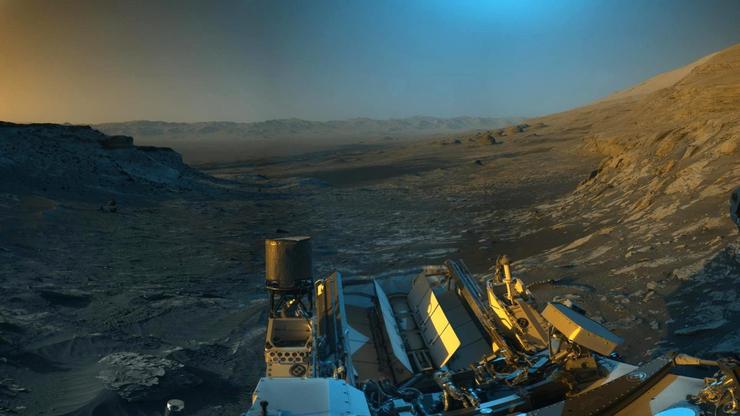
2021

2023

2026
2021
2023
2026
#40
Science / Re: Mars Curiosity Thread.
Last post by Dark Lightning - September 30, 2026, 09:56:47 PMI read about that this morning. "Postcards from Mars" 