- Welcome to Happy Atheist Forum.

Just be happy.
Recent posts
#11
Science / Re: The Smith Hat and Light
Last post by Recusant - September 16, 2026, 05:04:51 AMAgreed. Photons can still show us new things. It's intriguing that there is some subtle regularity lurking in the non-pattern of the Smith hats.
When doing further investigation of this, as I often do with interesting science news, I found that while the science news site published it just now in September, the paper came out in July. There are a couple of articles about it on a site called "ScholarPeer." I'm not sure about the authorship of those articles though. These days people seem to make a point of signaling that they wrote a piece, not AI. When I see an anonymous byline ("ScholarPeer Editorial Team") I suspect AI.
Still, the description of the creation of the Smith hat (a retired print technician in Yorkshire came up with it), and explanation of how the shape relates to non-repeating crystalline structures seemed good to me.
That's in "What Is the Smith Hat?". There's another from the same site on the topic which at least has a human byline: "One Tile Shape Makes a Chip Care Which Way Light Spins".
Missed in the OP: The paper itself is open access:
"Chiral diffraction from aperiodic monotile structure" | Nature Communications
When doing further investigation of this, as I often do with interesting science news, I found that while the science news site published it just now in September, the paper came out in July. There are a couple of articles about it on a site called "ScholarPeer." I'm not sure about the authorship of those articles though. These days people seem to make a point of signaling that they wrote a piece, not AI. When I see an anonymous byline ("ScholarPeer Editorial Team") I suspect AI.
Still, the description of the creation of the Smith hat (a retired print technician in Yorkshire came up with it), and explanation of how the shape relates to non-repeating crystalline structures seemed good to me.
That's in "What Is the Smith Hat?". There's another from the same site on the topic which at least has a human byline: "One Tile Shape Makes a Chip Care Which Way Light Spins".
Missed in the OP: The paper itself is open access:
"Chiral diffraction from aperiodic monotile structure" | Nature Communications
QuoteAbstract:
Aperiodic systems, such as quasiperiodic structures, exhibit properties distinct from those of periodic structures. In 2023, Smith et al. discovered an aperiodic structure based on a single tile shape that can tessellate the plane only aperiodically, known as an aperiodic monotile.
Here, by using this monotile tiling, we propose a quasiperiodic structure which possesses perfect threefold rotational (C3) symmetry but lacks mirror symmetry. Diffraction experiments reveal quasicrystalline properties of the proposed aperiodic structure through observation of clear Bragg peaks and independence of illumination position.
Furthermore, we observe chiral properties including pinwheel-like diffraction patterns and unconventional circular-polarization-dependent behavior, which is absent in conventional quasiperiodic structures with mirror symmetry. These findings establish chiral quasiperiodic structures as a platform for studying aperiodic systems beyond traditional quasicrystals, broadening the study of nonperiodic structures.
#12
Science / Re: The Smith Hat and Light
Last post by Dark Lightning - September 16, 2026, 02:06:44 AMI saw that this morning. Very cool!
#13
Science / The Smith Hat and Light
Last post by Recusant - September 15, 2026, 11:05:19 PMCertainly we've had threads that have least mentioned Penrose tiling and related ideas. I'm pretty sure there's at least one devoted solely to that topic, but a few stabs with the site search didn't bring anything up that seemed to fit the bill.
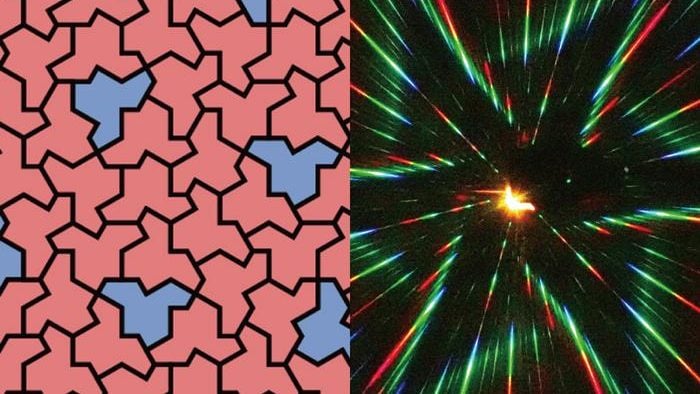
Thus a new thread it born. I think this is just really cool. A "Smith hat" is a 13-sided polygon that fits the bill: a single shape that can cover a surface without ever repeating. Somebody came up with the idea of shining light through a transparent surface covered by the Smith hat shape. . .
"The shape behind the Einstein problem just revealed strange new physics" | ScienceDaily
Thus a new thread it born.
I think this is just really cool. A "Smith hat" is a 13-sided polygon that fits the bill: a single shape that can cover a surface without ever repeating. Somebody came up with the idea of shining light through a transparent surface covered by the Smith hat shape. . ."The shape behind the Einstein problem just revealed strange new physics" | ScienceDaily
Quote
Researchers from the Institute of Industrial Science, The University of Tokyo experimentally demonstrate unique optical behavior from a long-sought aperiodic pattern. Credit: Institute of Industrial Science, The University of Tokyo
In a study published in Nature Communications, researchers from the Institute of Industrial Science, The University of Tokyo, and collaborating institutions built optical structures inspired by the "Smith hat." This unusual shape is known for solving the so-called Einstein problem in mathematics. When the team illuminated the structures with laser light, they observed diffraction effects unlike those seen in conventional quasicrystals.
The Einstein problem asks whether a single tile shape, known as a "monotile," can cover an entire surface without creating a repeating pattern.
Familiar tilings such as checkerboards and honeycombs repeat in a regular way. An aperiodic monotile, by contrast, can fill a surface without ever settling into a repeating arrangement.
[. . .]
"What is especially fascinating about the hat tile is that, although the resulting pattern appears irregular at first glance, it is actually constructed from the honeycomb lattice," says lead author Yuto Moritake. "We wanted to see whether this unique shape could also produce any unexpected physical phenomena."
To test that possibility, the researchers created nanoscale versions of the pattern on silicon nitride films using electron beam lithography.
When laser light was directed at the structures, the resulting diffraction patterns formed distinctive pinwheel-like shapes. These patterns directly revealed the chiral character of the aperiodic structure.
Chirality refers to a form of handedness in which a structure and its mirror image cannot be perfectly matched. In this case, the unusual arrangement of the monotile pattern caused the light itself to display a chiral response.
"We found that the diffraction patterns themselves become chiral because the structure lacks mirror symmetry," explains senior author Masaya Notomi. "This kind of optical response is fundamentally different from that observed in conventional quasicrystalline materials."
[Continues . . .]
#14
Religion / Re: Evangelists
Last post by billy rubin - September 15, 2026, 03:18:41 PMwhen did england become a country of peace that abjures fighting?
#15
Religion / Re: Evangelists
Last post by zorkan - September 15, 2026, 12:57:41 PMMeanwhile at Speakers' Corner in Hyde Park London lies proof of religious peace after 90 seconds.
https://www.youtube.com/watch?v=0dS3CCM1XOU
Proof of bullshit, too.
https://www.youtube.com/watch?v=pEoMKmTqsMM
https://www.youtube.com/watch?v=0dS3CCM1XOU
Proof of bullshit, too.
https://www.youtube.com/watch?v=pEoMKmTqsMM
#16
Religion / Re: Evangelists
Last post by Dark Lightning - September 13, 2026, 11:40:41 PM That kind of sang froid is something I don't have. It was a Waldorf school, and I didn't want to terrorize the students. At least beyond a little math. Please don't judge, I just needed the money. I modified my previous post. It should have read ..."thought came to me..." I missed to the word "came".
 #17
Religion / Re: Evangelists
Last post by billy rubin - September 13, 2026, 11:30:22 PMi am truly sorry that you had to let that opportunity slip by. those are the moments that make life worth living.
my father once worked with an operations geologist in oklahoma.
operations geologists drive hundreds of miles with no sleep. AMHIK
anyway, the guy fell asleep and ran the car off the road. it hit the ditch, flipped, and skidded on its roof into a gas station and stopped by the pumps.
the attendant ran out,
my god! my god! are you okay??
and the geologist, upside down, had the presence of mind to look him in the eye and say,
fill 'er up!
my father once worked with an operations geologist in oklahoma.
operations geologists drive hundreds of miles with no sleep. AMHIK
anyway, the guy fell asleep and ran the car off the road. it hit the ditch, flipped, and skidded on its roof into a gas station and stopped by the pumps.
the attendant ran out,
my god! my god! are you okay??
and the geologist, upside down, had the presence of mind to look him in the eye and say,
fill 'er up!
#18
Religion / Re: Evangelists
Last post by Dark Lightning - September 13, 2026, 04:41:36 PMHeh, when I was teaching a math class many years ago, one of the students blurted, "Why are you doing this to us?". I told one of the other teachers that the thought came to me of saying, "I've come for your souls. Give them to me now!", in that James Earl Jones voice. Of course, I didn't say that to the class. The other teacher was amused.
#19
Religion / Re: Evangelists
Last post by billy rubin - September 13, 2026, 01:49:08 PMa friend of mine in school once told me about his response to college campus performative evangelizing. he put on a black cloak, iirc, and stood next to them evangelizing for satan as an alternative.
i was not there but i imagine the entertainment value alone would have been high.
i was not there but i imagine the entertainment value alone would have been high.
#20
Religion / Re: Evangelists
Last post by Dark Lightning - September 12, 2026, 06:02:51 PMMan, that's annoying. I don't see any of that around here. Probably if I went into Los Angeles, or something.