- Welcome to Happy Atheist Forum.

Just be happy.
Recent posts
#81
Science / Re: Not science as such but . ...
Last post by Dark Lightning - August 15, 2026, 07:33:03 PMIt doesn't help that people lacking pretty much any qualifications are being placed in positions of authority in the US gov. And a large segment of the population trusts them.
#82
Science / Re: Not science as such but . ...
Last post by Recusant - August 15, 2026, 07:11:43 PMIt's not necessarily stupidity when somebody rejects scientific findings or public health advice. Stupidity may come into it but other factors are at play, including political alignment and insular media ecosystems.
"Scientific advancement has never been more prolific—so why has trust in science plummeted?" | Phys.org
"Scientific advancement has never been more prolific—so why has trust in science plummeted?" | Phys.org
QuoteFrom genome editing to quantum computing, scientific progress is accelerating at an unprecedented pace, yet public faith in science is collapsing. Our species has mapped the human genome, created powerful computers that sit in the palms of our hands and extended human life spans beyond what our ancestors could have imagined—meanwhile, anti-intellectual movements are gaining momentum.
In his new book Anti-Science: Shortcuts to a Big Idea, Dariusz Jemielniak argues that this is not because of public ignorance or a failure to communicate science to the masses. Instead, we're witnessing and living through something far more complex: a fundamental shift in how society relates to knowledge itself.
"We have entered a period in which the relationship between information and truth has become fundamentally contested," Jemielniak of Kozminski University explains. "The technologies that promised democratized access to knowledge have also democratized access to falsehood."
Survey data from the mid-20th century showed high levels of confidence in scientists and scientific institutions. Science was associated with progress, prosperity and problem-solving, and the profession itself was well-respected.
Today, that well of public trust has been dramatically drained. There are many complex factors behind this decline, Jemielniak explains, including corporate-influence scandals, well-publicized cases of fraud, high-profile retractions and the sheer volume of scientific information now produced.
These factors alone are not enough to erode public trust, he explains. But when combined with a perfect storm of digital infrastructure that encourages the rapid sharing of shock-factor information, they are. Social media algorithms amplify sensational claims regardless of truth value, while echo chambers make it easy to find communities that validate virtually any belief.
"What is historically distinctive is the contemporary infrastructure that accelerates these cycles by rewarding outrage, simplifying complex disputes into identity signals, and turning epistemic conflict into content," Jemielniak explains.
Some scholars argue that humanity is even entering "a new Dark Ages driven by anti-intellectualism." Jemielniak says, "The proliferation of digital platforms has allowed misinformation to spread rapidly, challenging the public's ability to discern credible information and contributing to this erosion of trust."
[Continues . . .]
#83
Politics / Re: Duke of Bullshit: "The" Do...
Last post by billy rubin - August 12, 2026, 04:19:18 PMwant a prediction? i have a prediction.
here is my prediction for the american midterm elections.
as he did in every election he's ever been involved with, trump is planning to accuse his opponents of stuffing ballot boxes, signing up invalid voters, hacking the election machines, discarding republican votes, and so on..
there are 83 days until election day. trump will prepare the country for this accusation with internet posts, media interviews, press releases, and talking sycophants, getting more intense and rallying his supporters in th econgress and in the populace as election day approaches.
on election night, not too late, while the election is in progress, trump will announce that he has discovered fraud. he will send in ICE or th enational guard to close polling places in democratic regions while people are still standing in line outside, he will forcibly confiscate voting machines and ballot boxes, and he will disrupt the election so thoroughly that it will have to be halted.
that will take the political confrontation out of the election process and into congress and the courts.. trump already has a congress who will support him and has enough of a majority in the supreme court that he can get much of what he wants there. and if he doesnt like the results of the legal procedures, he can do what he always does and simply ignore them.
by doing this, all the current republicans in congress stay in power indefinitely, and he can continue to work the chaos to his advantage.
trump will demand that the election be postponed until he can certify that it will be fair. it will never be certified. if there is another election, trump will have his goons in every polling place and will supervise the ballots.
i could certainly be wrong about this, but nothing here seems very far-fetched anymore.
here is my prediction for the american midterm elections.
as he did in every election he's ever been involved with, trump is planning to accuse his opponents of stuffing ballot boxes, signing up invalid voters, hacking the election machines, discarding republican votes, and so on..
there are 83 days until election day. trump will prepare the country for this accusation with internet posts, media interviews, press releases, and talking sycophants, getting more intense and rallying his supporters in th econgress and in the populace as election day approaches.
on election night, not too late, while the election is in progress, trump will announce that he has discovered fraud. he will send in ICE or th enational guard to close polling places in democratic regions while people are still standing in line outside, he will forcibly confiscate voting machines and ballot boxes, and he will disrupt the election so thoroughly that it will have to be halted.
that will take the political confrontation out of the election process and into congress and the courts.. trump already has a congress who will support him and has enough of a majority in the supreme court that he can get much of what he wants there. and if he doesnt like the results of the legal procedures, he can do what he always does and simply ignore them.
by doing this, all the current republicans in congress stay in power indefinitely, and he can continue to work the chaos to his advantage.
trump will demand that the election be postponed until he can certify that it will be fair. it will never be certified. if there is another election, trump will have his goons in every polling place and will supervise the ballots.
i could certainly be wrong about this, but nothing here seems very far-fetched anymore.
#84
Laid Back Lounge / Re: Multi-Association Thread
Last post by billy rubin - August 12, 2026, 02:29:54 PMid do it but my money is in less supply than my interest
#85
Science / Evolution without natural sele...
Last post by zorkan - August 12, 2026, 12:56:11 PMNow watched every episode of Chris Packham's TV series called quite simply "Evolution".
Of course I've always been aware of Darwin, Dawkins, Gould, so why should I think that evolution proceeds by any other way?
Yet I can't recall Packham even mentioning natural selection.
He does imply artificial selection with horses.
It's certainly a new take.
https://www.theguardian.com/tv-and-radio/2026/jul/10/we-didnt-develop-heads-until-wed-evolved-an-arse-i-like-that-chris-packhams-epic-ode-to-evolution
Of course I've always been aware of Darwin, Dawkins, Gould, so why should I think that evolution proceeds by any other way?
Yet I can't recall Packham even mentioning natural selection.
He does imply artificial selection with horses.
It's certainly a new take.
https://www.theguardian.com/tv-and-radio/2026/jul/10/we-didnt-develop-heads-until-wed-evolved-an-arse-i-like-that-chris-packhams-epic-ode-to-evolution
#86
Laid Back Lounge / Re: Multi-Association Thread
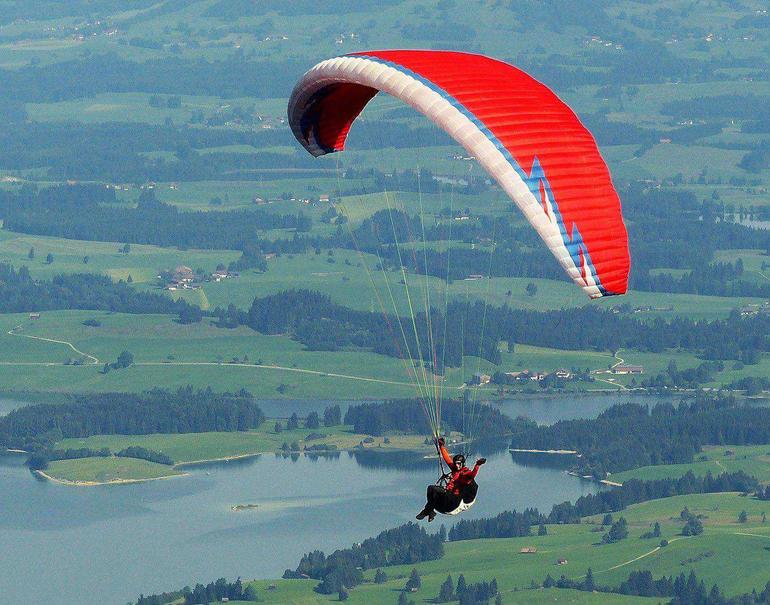
Last post by Recusant - August 12, 2026, 06:05:09 AMNever done hang-gliding, but did paragliding a few times and it was a blast. Even learning to control the beast while standing on the ground was fun as far as I was concerned. However the fellow who was teaching me moved away and wasn't willing to sell his old wing (that I'd been learning on). He felt that it would soon no longer be flyable and I wasn't proficient enough to fly unsupervised anyway. To be fair, I did have some less than graceful landings. Couldn't afford a wing, so that was the extent of my flying. The bones are more brittle now, but I'd still do it if given the chance. 
#87
Laid Back Lounge / Re: Multi-Association Thread
Last post by Dark Lightning - August 12, 2026, 04:19:44 AMAny danger in mathematics as posed in the article billy posted rests in the same realm as religious fanaticism. People don't like your work and harm you.
#88
Laid Back Lounge / Re: Multi-Association Thread
Last post by Icarus - August 12, 2026, 04:01:23 AMMath is often disappointing when I balance my checkbook.
#89
Laid Back Lounge / Re: Multi-Association Thread
Last post by billy rubin - August 12, 2026, 02:34:52 AM #90
Laid Back Lounge / Re: Multi-Association Thread
Last post by Dark Lightning - August 11, 2026, 10:13:54 PMI can get in that zone by doing math, and even when carving wood. Far less dangerous.